8 février 2027 – 13 février 2027
Ouverte aux réservations- Partenaire d’accueil
- Dakar, Senegal · Partenaire d’accueil à confirmer
- Langue de travail
- EN
- places
- 50 / 50 places
- Cours et services:
- 490,00 €
40 days left to register· until 15 décembre 2026
A6-2 · A Organisational capacity
Fifty people. Twenty-five organisations. Half from Europe, half from Sub-Saharan Africa. Five days in Dakar, and one thing to leave with: a project dossier that is ready to be submitted, built on a problem your community actually named.
This is not a course about project design. It is a design sprint with training inside it. From the first morning you work on your own proposal, with your own consortium, against a real call and a real deadline. The trainers move between tables. Artificial intelligence sits at every table as a drafting assistant — never as the author.
The room is built on one rule, repeated all week: AI drafts, the community decides. An evaluator can smell a proposal written by a machine from the first paragraph, and so can the young people who would have to live with it. What AI does here is remove the hours — reformatting, restructuring, checking consistency, translating, turning a problem tree into a needs analysis — so that the human hours go where they belong: into the evidence, the partnership and the honesty of the design.
The work happens in three phases. A two-hour online session four weeks before, where profiles are matched and the first consortia take shape. Four weeks of guided self-work at home, gathering the evidence your proposal will stand on. Then five intensive days in Dakar, where the drafts become dossiers.
Le programme détaillé est disponible en anglais.
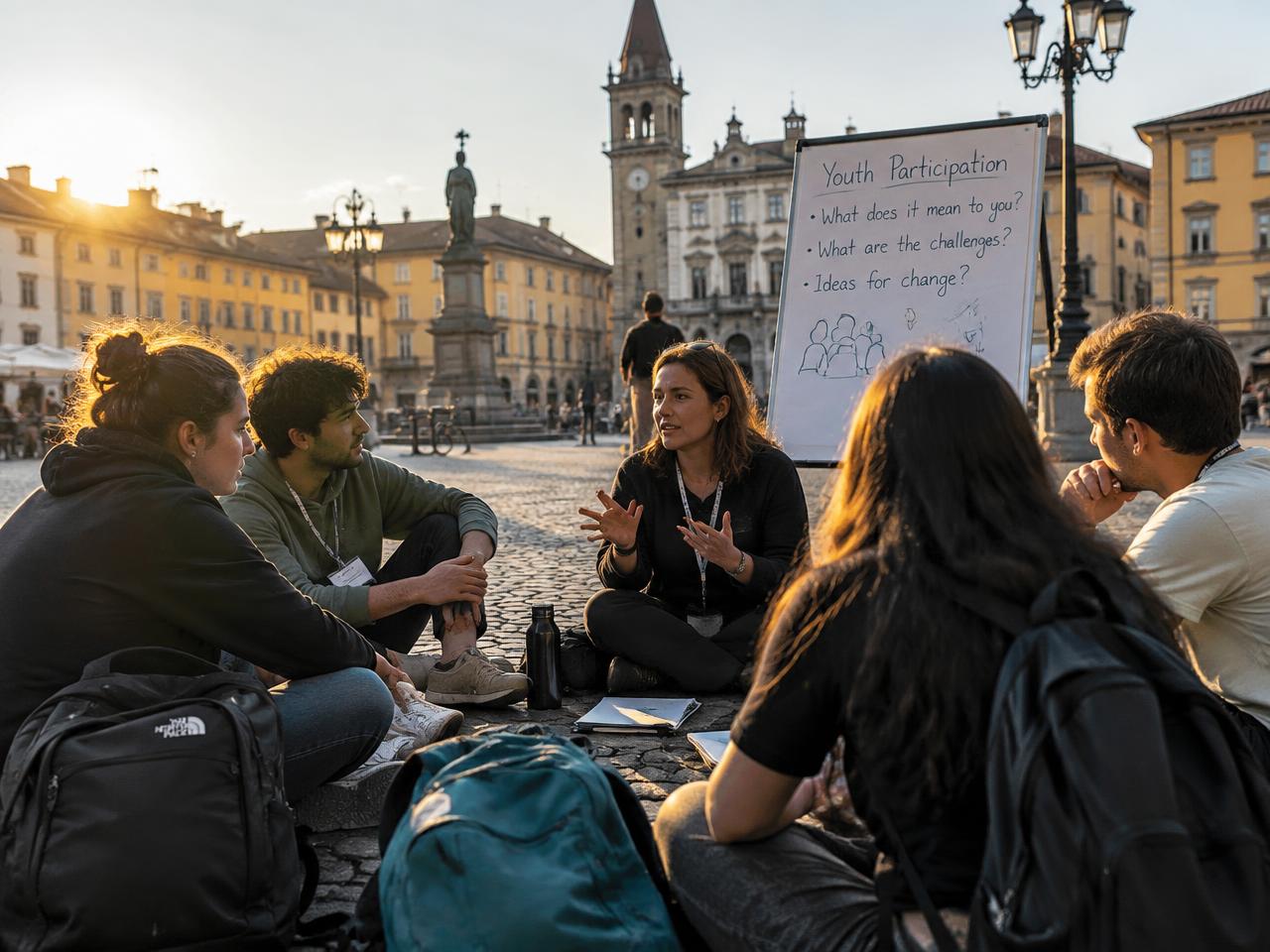
Photographies illustratives d'apprentissage non formel. Les photographies de ce cours et de ses lieux d'accueil seront ajoutées dès que les organisations partenaires les enverront.
This edition is designed for organisations that intend to apply, not for individuals gathering knowledge for later. Each participating entity sends two people: one who can commit the organisation, and one who will do the writing.
We are looking for 25 entities:
12–13 from Erasmus+ Programme Countries (EU Member States and associated countries) — youth NGOs, adult education providers, municipalities, youth centres, universities' third-mission units, social cooperatives
12–13 from Sub-Saharan Africa — youth associations, community organisations, educational NGOs, cooperatives, networks and their local authorities
The profile that fits:
You work with young people or with those who work with them, and you can name a problem your community has already identified — not one you have invented for a proposal
Your organisation has, or is in the process of obtaining, a PIC number
You have the institutional capacity to be a partner in a 24–36 month project, and preferably the ambition to coordinate one
You have at least a basic grasp of project cycle management — this course builds on A5 Project Design Fundamentals; if you have never written a logical framework, take A5 first or arrive having done the preparatory module
Your English is good enough to work in it all week; French is spoken in the room and in Dakar, and the trainers work in both
Who this is not for: organisations wanting a general introduction to Erasmus+ (take A5), individuals without an organisation behind them, and anyone hoping to receive a written proposal rather than write one.
Every ABARKA course is built with the same learning architecture we use in our own programmes and in the KA2 projects we coordinate: non-formal, practice-first, designed backwards from what the participant must be able to do on Monday morning back home. This edition pushes that further — Monday morning is during the course.
Three phases, one deliverable.
Phase 1 — Virtual kick-off (2 hours, four weeks before). Everyone online. Each entity presents its community problem in 90 seconds. Profiles are matched against the two calls. Draft consortia are formed in breakout rooms, each with a provisional coordinator and a working title. You leave the session knowing who you are probably working with — and what you must go and find out.
Phase 2 — Guided self-work (four weeks, about 8–10 hours). Each entity assembles its evidence pack: the problem as your community states it, three sources that corroborate it, what has already been tried locally, who the young people concerned are and how they were consulted. Draft consortia hold at least one call of their own. Everything is uploaded to the shared workspace before arrival, so that day one starts with material, not with introductions.
Phase 3 — Five intensive days in Dakar. Short inputs, long work blocks, tight deadlines, and a daily output that must exist before the room closes. Trainers rotate as consultants. Consortia red-team one another against the real scoring grid. AI labs are woven between the working blocks, never instead of them.
Phase 4 — Submission clinics (three online sessions at +2, +4 and +6 weeks). Because a dossier that is ready on Friday still has to be submitted. We stay with you until it is.
Working methods: problem-tree and root-cause mapping · theory-of-change canvassing · consortium market · structured AI labs with a shared prompt library · peer consultancy in the red-team format · live virtual-exchange demonstration · pitch rounds scored against the award criteria · daily reflection in national and mixed groups.
Follow-up of A5 Project Design Fundamentals and companion to A6 Project Design Enhanced with AI · ABARKA's internal AI agents and the EUGrantMaster methodology · Grantnest for call intelligence · NAI Digital Mentor experience · AI4ADU (KA122-ADU) · ABARKA's KA2 coordination practice since 2015 · the ESIRA international network, which supplies the European partners who review the drafts.
Field visit — Dakar region, day 3. Hosted by our local partner, we spend a morning with youth organisations working on the kind of problem most of the room is writing about. Not a showcase visit: participants come with three questions agreed the evening before, and the harvest session immediately afterwards asks one thing — what did we just see that changes our design? Several proposals are rewritten that afternoon. That is the point.
Live virtual exchange, day 3. A real 45-minute virtual exchange session, run with a partner youth group online in Europe, facilitated in front of the room. Participants proposing virtual exchange activities experience the method — the awkward first ten minutes, the connectivity drops, the facilitation moves that save it — before they write a word about it.
Four AI labs.
Lab 1 · The evidence assistant — turning a problem tree and local data into a needs analysis that survives an evaluator, with sources intact
Lab 2 · The indicator assistant — baselines, targets, means of verification, and how to avoid indicators you cannot actually measure
Lab 3 · The work plan assistant — activities, deliverables, milestones and effort, generated and then corrected by hand
Lab 4 · The consistency checker — does the budget match the work plan, do the indicators match the objectives, does the summary tell the same story as the annexes
Each lab compares an AI-assisted output side by side with a hand-made one, and names what was gained and what was lost. The prompt library used in the labs goes home with every participant under an open licence.
Ask the evaluator (evening, day 2). An experienced assessor answers questions off the record about what makes them stop reading.
Full day
08:30 · Registration and the wall of 25 problems. Coffee, badges, and each entity posts its one-page evidence pack on the wall. The room reads the wall before it hears a single presentation.
09:00 · Opening. Welcome by ABARKA and the Dakar host partner. Why this room exists: 50 people, 25 entities, 25 proposals, one deadline. The rule of the week is stated and written up — AI drafts, the community decides.
09:30 · Speed-rooting. No solutions allowed yet — anyone who proposes a project is stopped.
10:45 · Break.
11:00 · Problem clinic. Every assumption without a source is challenged out loud.
12:30 · Lunch.
14:00 · The two calls, side by side. Capacity Building in the field of Youth in Sub-Saharan Africa and Erasmus+ Virtual Exchanges in Sub-Saharan Africa.
15:00 · The fit test.
15:30 · Break.
16:00 · Consortium market. Facilitated so that no entity is left without a consortium.
17:30 · Lock-in. Twenty-five consortia declared: coordinator, partners, target call, working title. Written on the wall and photographed.
18:00 · Close.
19:30 · Welcome dinner and Dakar evening, hosted by the local partner.
Full day
09:00 · Reflection groups. Fifteen minutes in mixed groups: what shifted yesterday, and what are you now afraid of?
09:15 · Theory of change workshop.
10:45 · Break.
11:00 · AI Lab 1 — the evidence assistant.
12:30 · Lunch.
14:00 · Objectives and results.
15:30 · Break.
16:00 · AI Lab 2 — the indicator assistant.
17:15 · Output check.
18:00 · Close.
20:00 · Optional — Ask the evaluator. An experienced assessor, off the record, on what makes them stop reading.
Full day
08:15 · Departure. In the bus, each group reviews the three questions it agreed the evening before.
09:00 · Field visit to youth organisations in the Dakar region, guided by the local partner: how a community-rooted problem looks and sounds from the inside, and what the people living it think of the solutions being designed for them.
11:30 · Return and harvest. What did we see that changes our design?
12:30 · Lunch.
14:00 · Track split.
15:30 · Break.
16:00 · Live virtual exchange. A real 45-minute session run with a partner youth group in Europe, facilitated in front of the room — the awkward first ten minutes, the connectivity drop, the moves that save it — then debriefed as a method.
17:00 · Back to the drafts. What the field visit and the demonstration change on paper. Working time, trainers on call.
18:00 · Close.
Evening · Free. Dakar, on foot, in small mixed groups.
Full day
08:00 onwards · Breakfast at your own pace. No start time. The desk is staffed from 08:00 for anyone wanting directions, a taxi, or company.
09:00 · Optional outing A — Gorée Island. Ferry from the port, a guided visit to the island and the Maison des Esclaves, back in the early afternoon. A UNESCO World Heritage site and, for a room of Europeans and Africans building something together, a place that asks serious questions. Small group, real guide, and space afterwards for anyone who wants to talk about it rather than move straight on.
09:30 · Optional outing B — Ngor and the Almadies. Beach morning at the western tip of the continent: swimming, a pirogue across to Ngor island, lunch by the water. The lightest option, and the one most people choose.
09:30 · Optional outing C — Lac Rose and the dunes, for those who want to go further out, returning late afternoon.
10:00–13:00 · Slow work tables, by the water. For anyone who would rather think than travel: reserved tables at a beach café, shade, power sockets where they exist, two trainers present without an agenda. No deliverable, no report back. Some consortia rewrite an objective; some just work out who is really going to do what.
13:00 · Lunch wherever you are. Not organised, not paid for by the course; a short list of places at every price is published near each option.
Afternoon · Yours. Rest, the market at Soumbédioune, the city, a swim, a nap, a long call home. Nobody is counted.
17:30 · Optional — sunset harvest. Forty-five minutes on the terrace, voluntary, no laptops: what did your consortium talk about today that it had not said in the room? The best repair ideas of the week usually surface here, and they go on the wall for the next morning.
Evening · Free. Dinner in self-organised small groups; the venue serves a simple meal for anyone staying in.
Full day
09:00 · Work packages. Structure, sequencing, who leads what, and how to write a work package that a partner can actually deliver rather than one that reads well.
10:45 · Break.
11:00 · AI Lab 3 — the work plan assistant.
12:30 · Lunch.
14:00 · Budget clinic. What the call allows, lump sums and unit costs, realistic per-partner shares, transfers to African partners, and the two costs proposals always underestimate: connectivity, and bringing young people into the room.
15:30 · Break.
16:00 · Red-team peer consultancy. Written feedback, no diplomacy.
17:15 · The repair list. Each consortium names the three things it will fix tonight, and who is doing each one.
18:00 · Close.
20:00 · Optional — writing room open until 22:00, two trainers on call.
Full day
09:00 · Repair sprint, with AI Lab 4 — the consistency checker.
10:45 · Break.
11:00 · The anti-generic pass.
12:00 · Pitch round. Twenty-five pitches of three minutes, scored by the room against the award criteria. The five strongest and the five weakest are discussed openly, because both teach.
13:30 · Lunch.
14:30 · Submission plan. Per proposal: who submits, from which PIC, what is still missing, the date it will be submitted, and which follow-up clinic each consortium will attend.
15:30 · Commitment wall. Partnership declarations and letters of intent signed in the room, while everyone is still together and willing.
16:15 · Evaluation, Youthpass conversations and certificates.
17:30 · Closing circle.
19:30 · Farewell dinner.
ABARKA certificate of attendance with a learning-outcomes annex for validation · Youthpass for participants on the youth track · Europass Mobility for participants from school, VET and adult education organisations · a consortium certificate naming each entity, its role and the proposal it developed, usable as evidence of partnership-building in your application.
The certificate is issued to participants who complete Phase 1, submit the Phase 2 evidence pack and attend at least 80 % of the contact hours in Dakar. Attendance at the Phase 4 clinics is recorded and added to the annex.
Choose the number of participants, where the group comes from and any extra services to see the full cost.
Total1 018,50 €
Per participant1 018,50 €
Deposit (20%)203,70 €
Choisissez une date et envoyez votre demande. ABARKA examine chaque demande et confirme la place par écrit.
Les demandes sont ouvertes à toutes et tous, avec ou sans financement Erasmus+. La place est retenue dès qu’ABARKA la confirme ; un soutien solidaire peut être demandé dans le formulaire.
8 février 2027 – 13 février 2027
Ouverte aux réservations40 days left to register· until 15 décembre 2026
Ask about this course
Ask in your own words and you get an answer drawn from the published programme, dates, places and fees. For anything personal — invoices, visas, a confirmed booking — write to clotaire@ongabarka.org.